Back to overview
MediumTurkey

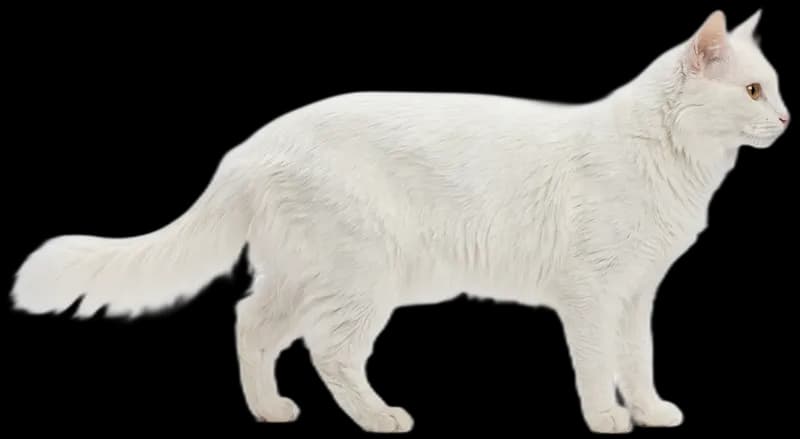
Turkish Angora

"The elegant Turkish Angora is one of the world's oldest cat breeds and is considered the 'ballerina' of cats. She captivates with her graceful appearance, silky coat without undercoat, and her lively, playful character. A wonderful, intelligent companion for active people seeking a close bond."

Your Height:
180 cm
Human
Turkish Angora
Shoulder Height: 23 cm
Age12-18 years
Average life expectancy with species-appropriate husbandry and good health.
Body Length
40-50cmBack Height: 20-25cm
Body length from nose to base of the tail.
Weight3.5-5 kg
Ideal body weight for a healthy, adult breed.
Cost/Month€60+
The sum of food, insurance, and basic care per month.

Character Profile

Activity Level
A measure of the daily urge to move and the necessary mental stimulation.

Highly agile, playful, and energetic; loves climbing and hunting.

Affection Level
How cuddly and attached the breed is – some cats constantly seek physical contact, others are more aloof.

Extremely people-oriented, wants to be actively involved in family life.

Independence
How well the cat can cope on its own. Independent breeds need less attention.

Confident but not a loner; requires social interaction.

Family Friendliness
Describes patience and adaptability when dealing with children and family bustle.

Very child-friendly and adaptable, enjoys playing with people.

Beginner Friendly
Indicates how well the breed is suited for first-time owners without much experience.

Uncomplicated nature, making it well-suited for cat beginners.

Apartment Friendly
Considers space requirements, the general need for rest, and how well the cat can cope with indoor living.

Well-suited for apartments, provided there are sufficient climbing options.

Grooming Effort
Time required for brushing, bathing, and nail care. Long-haired breeds often need daily care.

No undercoat, therefore low-maintenance; regular brushing is sufficient.

Shedding
How much loose hair the breed loses in the house. Important for allergy sufferers and cleaning effort.

Moderate shedding, but less than other longhair breeds.

Vocalization
How talkative the breed is. Some cats meow frequently and loudly, while others are rather quiet.

Communicative, but not as persistently vocal as a Siamese cat.

Did you know?

Keeping a pet of this size costs over 80€ per month on average. Plan your finances wisely.

Character & Training

The Turkish Angora is a highly intelligent, playful, and very active cat that easily wins over its owners with its charm. It is exceptionally people-oriented and prefers to be involved in everything rather than just watching. Its nature is cheerful, curious, and sometimes a bit demanding, which makes training easy with gentle consistency and plenty of play incentives. As one of the brightest breeds, it learns tricks quickly and highly appreciates interactive training. It is an excellent family cat that harmonizes very well with children. Nevertheless, it needs a cat-appropriate environment to constructively burn off its energy.

Living & Exercise

Due to its athletic nature, the Turkish Angora needs plenty of space to climb, jump, and hunt. While it is suitable for indoor keeping, it loves a secured balcony or garden to satisfy its urge for movement. Inside the home, sufficient scratching posts, climbing options, and interactive toys should be provided to prevent boredom. Because it is very social, it should by no means be left alone for long periods; an animal playmate is highly recommended. It is a very adaptable cat, as long as its needs for activity and mental stimulation are met.

Health & Grooming

The Turkish Angora is considered a robust and healthy breed with a high life expectancy. Since it does not have an undercoat, grooming is pleasantly simple and usually only requires weekly brushing to remove loose hair and maintain its shine. As a breed characteristic, there is an increased risk of deafness in pure white specimens, especially in blue-eyed animals. Responsible breeders also screen their cats for hypertrophic cardiomyopathy (HCM), a common heart disease in cats. With good care and a balanced diet, these cats usually remain active and vital into old age.

History

The roots of the Turkish Angora lie in the Ankara region (formerly Angora) of Turkey, where it has been considered a valuable treasure for centuries. As early as the 16th and 17th centuries, the first longhaired cats reached Europe via trade routes and were admired at the courts of kings and nobles. For a long time, it was the only known longhaired cat breed in Europe and played a significant role in the breeding of later breeds such as the Persian cat. After the breed almost fell into oblivion, the Ankara Zoo in Turkey initiated a targeted conservation program in the mid-20th century to preserve the purity of this noble cat.

Turkish Angora | Cat Breeds